
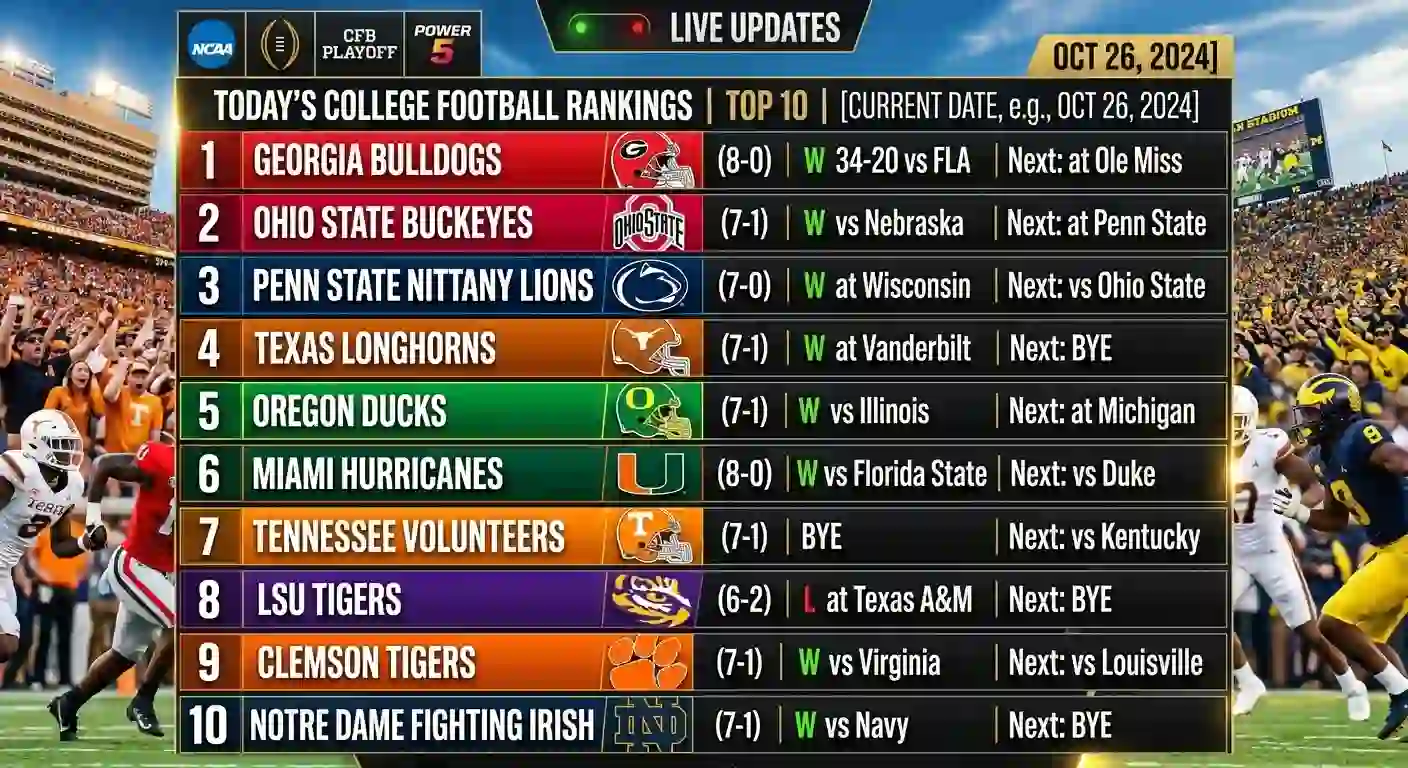
College Football Rankings Today: Full Breakdown & Analysis
Quick Summary / Key Takeaways
- College football rankings today reflect major shifts across the AP Top 25, Coaches Poll, and College Football Playoff (CFP) standings.
- The SEC and Big Ten continue to dominate the top 10, with Ohio State, Georgia, and Texas trading positions weekly.
- ESPN college football rankings often diverge from the AP Poll due to different voter pools and weighting methodologies.
- The 12-team CFP format has intensified competition for at-large bids, making every ranked matchup a de facto elimination game.
- Strength of schedule and quality wins now outweigh raw win-loss records more than ever in the committee’s evaluation.
Direct Answer Block
College football rankings today are updated weekly across three major polls — the AP Top 25, the USA Today Coaches Poll, and the CFP Selection Committee Rankings. These rankings evaluate FBS teams based on win-loss records, strength of schedule, head-to-head results, and conference championship outcomes to determine playoff seeding and bowl eligibility.
Introduction
The landscape of college football shifts every single Saturday. One upset in the SEC, one blowout in the Big Ten, and the entire hierarchy of the sport reshuffles before your eyes. If you’re checking college football rankings today, you already know that no lead is safe and no résumé is bulletproof.
The expanded 12-team College Football Playoff format has raised the stakes dramatically. Teams that once coasted into New Year’s Six bowls now find themselves fighting for at-large bids against conference rivals they haven’t even played yet. The margin between a first-round bye and a road trip to Tuscaloosa in December is razor-thin.
This breakdown dissects the current state of the rankings, explains the methodology behind each major poll, and identifies the teams most likely to climb — or crater — in the weeks ahead. Whether you follow the sport obsessively or just check the scores on Sunday morning, this is your definitive guide.
How College Football Rankings Are Determined Today
What methodology drives college football rankings today?
College football rankings today rely on three distinct systems. The AP Poll uses 62 media voters nationwide. The Coaches Poll surveys 62 active FBS head coaches. The CFP Selection Committee, a 13-member panel of former coaches, players, and administrators, releases its own rankings starting in mid-October, prioritizing game film, strength of schedule, and head-to-head results over raw record.
Each system carries different weight at different points in the season. Early on, the AP and Coaches Polls shape the narrative. By November, the CFP committee’s weekly rankings become the only numbers that truly matter for playoff positioning.
AP Poll vs. Coaches Poll vs. CFP Rankings
Understanding the differences between these three polls is critical for interpreting college football rankings today accurately.
| Ranking System | Voters | Release Day | Key Bias | Playoff Impact |
|---|---|---|---|---|
| AP Top 25 | 62 media members | Sundays | Favors brand-name programs early | None directly |
| Coaches Poll | 62 FBS head coaches | Sundays | Conference loyalty, recency bias | None directly |
| CFP Rankings | 13-member committee | Tuesdays (mid-Oct onward) | Game film, SOS, head-to-head | Determines all 12 playoff seeds |
The AP Poll and Coaches Poll are legacy systems. They influence public perception, bowl tie-ins, and recruiting narratives. But the CFP Rankings are the only metric that directly determines who plays in January.
ESPN College Football Rankings: What Sets Them Apart
How do ESPN college football rankings differ from the AP Poll?
ESPN college football rankings are generated through the FPI (Football Power Index), a predictive model that simulates the remainder of the season thousands of times. Unlike the AP Poll, which reflects past results, FPI projects future performance using efficiency metrics, returning production data, and rest advantages. This makes it more forward-looking but occasionally controversial among traditionalists.
FPI frequently ranks one-loss Power Four teams above undefeated Group of Five squads, a divergence that sparks debate every October. The model also accounts for margin of victory in a way the CFP committee publicly claims it does not — though anyone watching the committee’s decisions knows blowout wins clearly influence their evaluations.
For bettors and fantasy players, ESPN college football rankings via FPI often provide a sharper edge than consensus polls because they strip away name-brand bias and focus on underlying efficiency.
Deep Dive: Teams Defining the Rankings Right Now
The SEC Stranglehold
Georgia, Texas, and Alabama remain the gravitational center of college football rankings today. The Bulldogs’ defensive front seven, anchored by elite edge rushers and a ball-hawking secondary, consistently ranks in the top five nationally in EPA per play allowed.
Texas has transformed under its current coaching staff into a complete team. The Longhorns’ quarterback play, explosive run game, and improved offensive line depth make them a nightmare matchup for any defense in the country.
Alabama continues to reload. The Crimson Tide’s transfer portal strategy and five-star recruiting classes ensure they never fall far from the top 10, even during rebuilding years that would be championship seasons for most programs.
Big Ten Power Surge
Ohio State and Penn State have turned the Big Ten into a two-headed monster at the top of the rankings. The Buckeyes’ receiving corps is arguably the most talented in the sport, featuring multiple future first-round NFL Draft picks who create mismatches on every route tree.
Oregon and Michigan round out the Big Ten’s elite tier. The Ducks’ tempo-based offense generates explosive plays at a rate that stresses even the most disciplined defenses, while Michigan’s physical, ground-and-pound identity remains a stylistic counter to the spread-heavy teams dominating the SEC.
The Group of Five Wildcard
Don’t sleep on Boise State, Tulane, or Memphis. Under the 12-team CFP format, the highest-ranked Group of Five conference champion receives an automatic bid. This means a 12-1 Mountain West or AAC champion could leapfrog a three-loss SEC team in the final rankings — and the committee has already signaled willingness to reward dominant G5 résumés.
Expert Sports Analysis: What the Data Tells Us
The most revealing metric in college football rankings today isn’t win-loss record. It’s SP+, Brian Furlong’s efficiency-based rating system hosted on ESPN. SP+ adjusts for opponent strength and tempo, isolating how well a team actually performs on a per-play basis.
Teams that consistently rank in the top 10 of SP+ but sit lower in the AP Poll are prime candidates for a rankings surge. Conversely, teams riding high in the AP on the strength of soft non-conference schedules tend to regress once conference play intensifies.
Key takeaway: Trust efficiency metrics over record. A 9-1 team with a top-five SP+ rating is a more dangerous playoff threat than an 11-0 team ranked 40th in efficiency.
[Link: Relevant internal article on CFP bracket projections]
Common Pitfalls & Strategic Mistakes in Reading Rankings
Overvaluing early-season blowouts. A 52-7 win over an FCS opponent in September tells you almost nothing about a team’s playoff viability. The CFP committee knows this, even if casual fans don’t.
Ignoring strength of schedule. A 10-2 record in the SEC is fundamentally different from a 10-2 record in the Mountain West. Always cross-reference rankings with SOS data from sources like ESPN college football rankings or the NCAA’s official metrics.
Chasing the “eye test” over data. The eye test matters — the CFP committee literally watches game film — but it should complement statistical analysis, not replace it. Teams that look dominant against weak opponents often crumble under the speed and physicality of elite competition.
Forgetting conference championship implications. In the 12-team era, winning your conference championship game can vault a team from the 8-seed to a first-round bye. Never evaluate rankings in a vacuum without considering the remaining schedule.
Frequently Asked Questions
When do college football rankings come out each week?
The AP Poll and Coaches Poll release every Sunday during the season, typically around 2:00 PM ET. The CFP Selection Committee releases its rankings every Tuesday evening starting in mid-October through Selection Sunday in early December.
How many teams make the College Football Playoff?
Twelve teams qualify for the College Football Playoff under the current format. The five highest-ranked conference champions receive automatic bids, and the next seven highest-ranked teams earn at-large spots. The top four seeds receive first-round byes.
Why do ESPN college football rankings differ from the AP Poll?
ESPN college football rankings use the FPI, a predictive algorithm based on efficiency, returning production, and projected outcomes. The AP Poll reflects human voter opinions of past results. FPI looks forward; AP looks backward.
Can a two-loss team make the College Football Playoff?
Yes. Under the 12-team format, a two-loss team from a Power Four conference with a strong strength of schedule and quality wins can absolutely earn an at-large bid. The committee values résumé quality over raw loss count.
Do Group of Five teams have a realistic path to the playoff?
Absolutely. The highest-ranked Group of Five conference champion receives an automatic bid regardless of record. A dominant Boise State or Tulane squad can secure a playoff spot over a mediocre Power Four team with a better record.
What is the most important metric for CFP rankings?
The CFP committee emphasizes game film evaluation, strength of schedule, head-to-head results, and conference championship outcomes. No single metric dominates, but SOS and quality wins carry the most weight in close comparisons.
How often do college football rankings today change dramatically?
Major shakeups occur almost every week during conference play, especially in November. A single top-10 upset can trigger a cascade of movement across all three polls, reshuffling playoff projections entirely.
Conclusion
College football rankings today are more volatile, more consequential, and more debated than at any point in the sport’s history. The 12-team CFP format has turned every ranked matchup into a high-stakes chess match, where a single loss can mean the difference between a first-round bye and a road game in hostile territory.
The key to reading the rankings intelligently is simple: look beyond the win-loss column. Cross-reference the AP Poll with ESPN college football rankings, study efficiency metrics like SP+ and EPA per play, and always factor in strength of schedule before drawing conclusions.
The season is far from over, and the teams sitting atop the rankings right now are not guaranteed to be there in December. That’s what makes college football the most unpredictable, most thrilling sport in America.